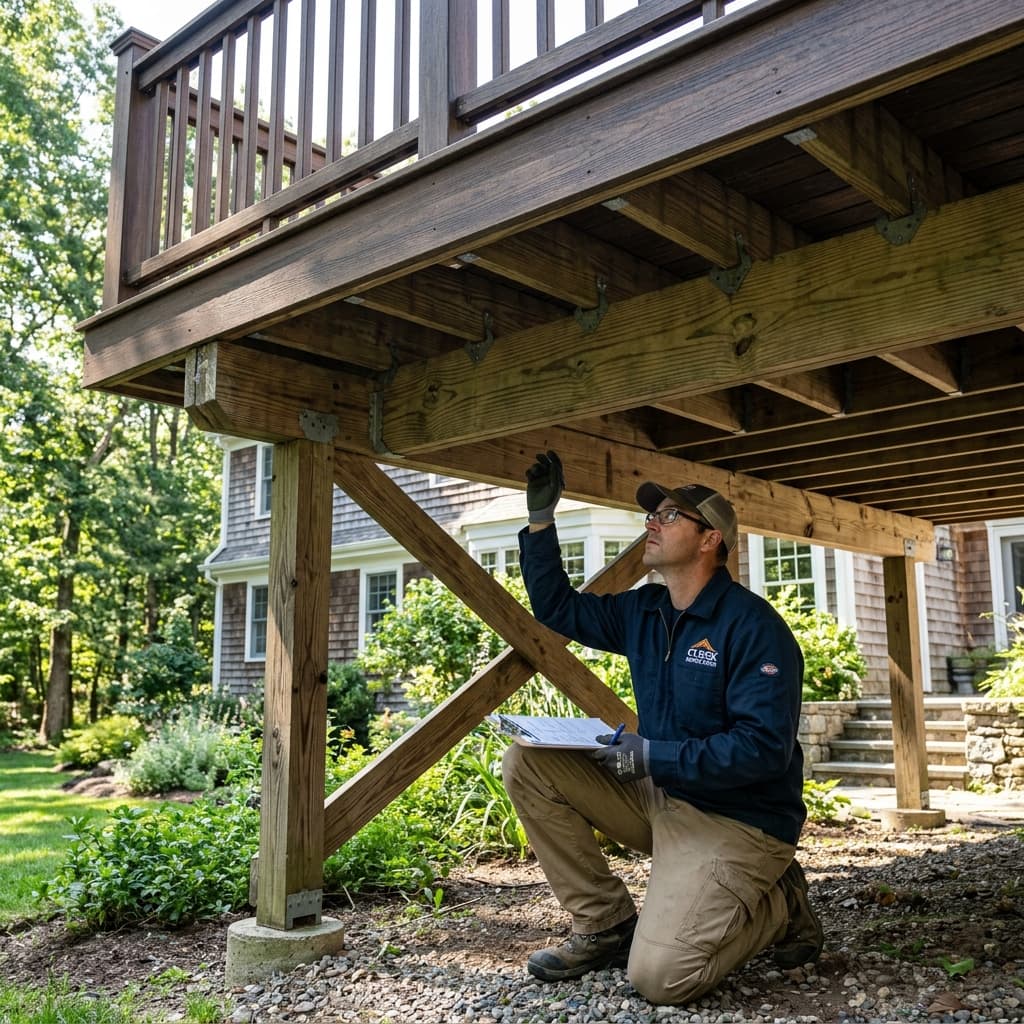
Deck Evaluation in Connecticut
We inspect the entire deck — boards, railings, stairs, joists, beams, posts, footings, fasteners, flashing and the connection to your home — then explain what can be repaired, what can be reused and when replacement makes more sense.
What a Deck Evaluation Covers
A complete deck evaluation examines the visible surface, underside structure, connections and surrounding conditions. We check boards, railings, stairs, joists, beams, posts, footings, fasteners, flashing, ledger connections, drainage patterns and signs of movement. Where accessible, we probe for hidden rot, check fastener integrity and assess the condition of the ledger board — the critical connection between the deck and the home.
What Can Be Assessed Visually
Surface board condition, railing stability, stair alignment, post plumb, beam bearing, joist spacing and condition, visible fastener corrosion, flashing presence and condition, ledger attachment and general drainage. We note areas that require further investigation, such as inaccessible framing, embedded posts or concealed connections.
Boards and Surface Materials
We examine decking boards for splitting, checking, cupping, soft spots, fastener pull-through, surface degradation, coating failure and previous repair patterns. Board condition alone does not determine whether the deck is safe or salvageable — the framing must be evaluated independently.
Railings, Guards and Stairs
Loose railings, unstable balusters, missing graspable handrails and uneven stairs are safety concerns that often require immediate attention. We check guard height, baluster spacing, post attachment, stair stringer condition, riser and tread consistency, and landing stability.
Joists, Beams and Connections
The framing beneath the deckboard determines whether the structure can be preserved. We evaluate joist condition, spacing, bearing, blocking, beam connections, post-to-beam attachment and overall framing alignment. Rot near the house connection or at beam pockets often indicates more extensive hidden damage.
Posts and Footings
Posts that are leaning, split, rotted at grade or inadequately connected to footings compromise the entire structure. We check post bases, post-to-footing connections, concrete condition and evidence of frost heave or settlement.
Ledger and Flashing
The ledger board connects the deck to the home and is the most common failure point. We look for missing or improperly installed flashing, water staining on the house band, ledger fastener pattern and spacing, and any visible separation or movement.
What the Homeowner Receives
After the evaluation, you receive a written summary of findings, photographs of notable conditions, a repairability assessment, frame reuse considerations, resurfacing suitability analysis and clear replacement indicators. You will understand whether repair, resurfacing or replacement is appropriate — and why.
Common Questions About Deck Evaluation
Do I need a permit to build or repair my deck?
Yes, in most Connecticut towns, any deck that attached to the house or is over 30 inches off the ground requires a building permit. Don't worry, we handle all the permit paperwork and inspections for you.
What is the best material for a deck in Connecticut?
Composite decking (like Trex or TimberTech) is highly recommended for Connecticut weather because it resists moisture, mold, and doesn't splinter. However, pressure-treated wood or cedar are excellent, cost-effective options if you are willing to keep up with bi-annual staining.
Can I just replace the top boards and keep the frame?
Yes! If your deck's underlying structure (joists, beams, and ledger board) is sound and properly flashed, we can perform a 'deck resurfacing.' This saves you thousands of dollars while giving you a brand-new looking deck surface and railings.
How long does a typical deck project take?
Small repairs can often be done in 1-2 days. A surface replacement might take 3-5 days. A complete custom build can take 1-3 weeks once permits are approved and materials are delivered.
Cost Factors
- Deck size and height
- Number of levels
- Accessibility for inspection
- Whether selective removal is needed
- Documentation review
Timeline
1–3 hours onsite, report within 2–3 business days
Written Project Scopes
Every proposal defines the included work, project assumptions, selected materials, pricing and next steps.
HIC.0705773
Connecticut-registered home improvement contractor. Fully insured. Written project scopes. Repair, resurfacing and replacement options.